
French i /i/ and u /y/
Keep the tongue in the /i/ position, then round the lips to reach /y/.
Compare 14 French vowel targets with IPA, clear mouth cues, spelling examples, and checked-in reference audio.
Start with /i/ Try the listening check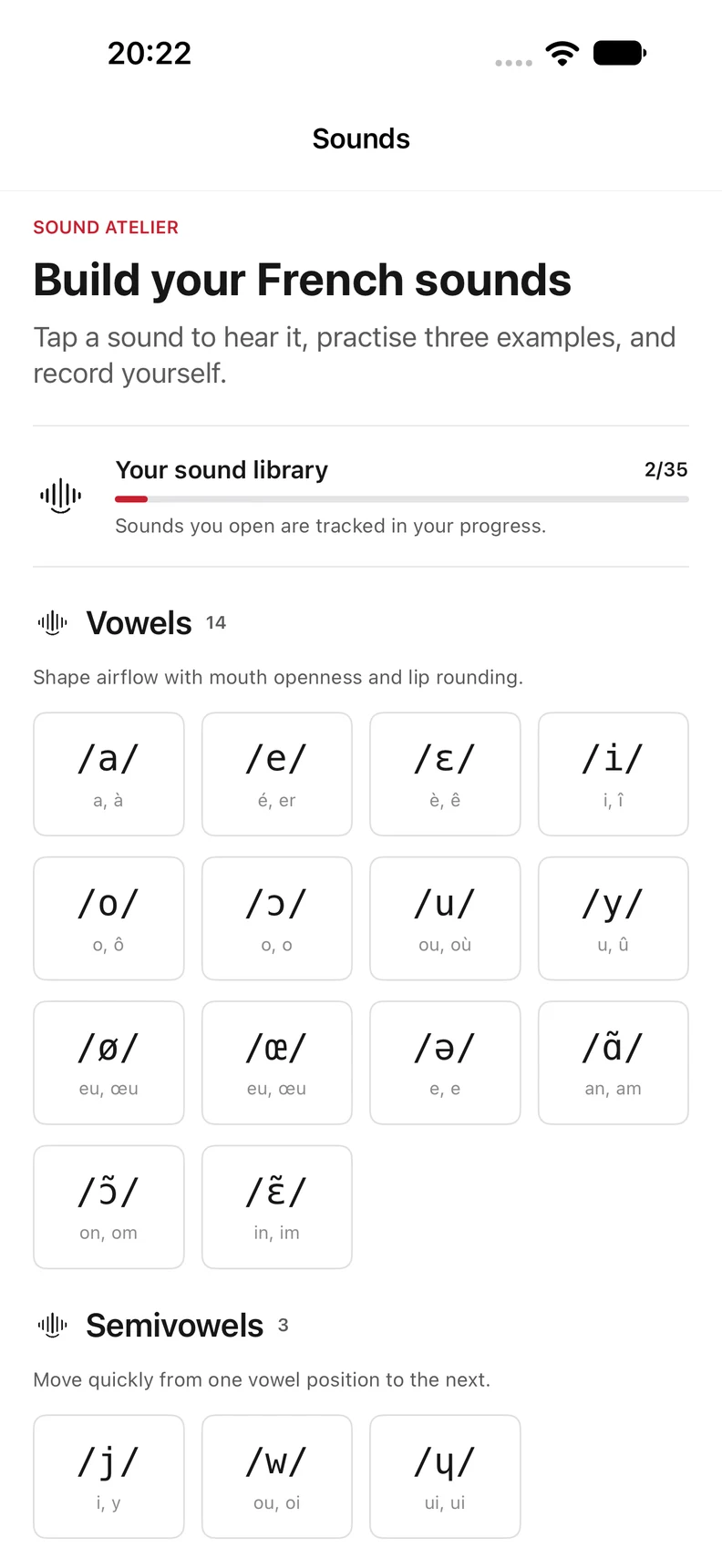
Choose a vowel pair, listen to an unlabelled clip, then select what you heard. Each answer reveals a mouth-position cue.
Start a round when you are ready. No microphone or sign-in is needed.
This counts your choices for six synthetic reference clips. It does not assess your voice, accent, or ability to understand every speaker.
For a guided speaking task, try Parle's first four Course missions and all 35 Sounds pages for free. Premium opens the complete 120-mission course.
Try free Sounds in Parle See the four free Course missionsThese clips demonstrate isolated synthetic vowels, not full-word recordings. Your answers stay in this tab and reset when you leave. Review the four contrasts.
lit, île, style
Stretch your lips as far as you can, as in “lit” or “île.”
Audio stays on this page. The trainer does not score your accent, pronunciation, or CEFR level.
Every control plays a local reference clip. Use the words as spelling examples, not as universal pronunciation rules.
Keep the lips relaxed or lightly spread. Change tongue height without adding an English glide.
Hold the lip shape steady. Let the tongue position separate French u, ou, eu, and o sounds.
Keep the vowel open and resonant. Do not add a final n or m sound after it.
Need the spelling rules and exceptions? Open the French AN, EN, IN, and ON pronunciation guide.
Alternate a pair slowly. The goal is a repeatable physical difference, not a perfect score.
Keep the tongue in the /i/ position, then round the lips to reach /y/.
Both sounds use rounded lips. The tongue stays forward for /y/ and moves back for /u/.
Lower the tongue and open the jaw slightly for /ɛ/. Keep both vowels steady.
Keep the lips rounded. Open the jaw and lower the tongue slightly for /ɔ/.
Choose a lesson, then return to the listening questions above.
Watch, listen, then practise · 1 minute 33 seconds
Hear /y/ and /u/. Then test your listening. Listen, pause to practise and check what you heard.
Original Parle lesson with English captions, AI-assisted graphics and synthesized reference audio. The vowel clips model isolated sounds; written words are examples, not word recordings. Watch on YouTube · Read the captions. Open this video lesson · All free video lessons.
Watch, listen, then practise · 1 minute 33 seconds
Hear /e/ and /ɛ/. Then test your listening. Listen, pause to practise and check what you heard.
Original Parle lesson with English captions, AI-assisted graphics and synthesized reference audio. The vowel clips model isolated sounds; written words are examples, not word recordings. Watch on YouTube · Read the captions. Open this video lesson · All free video lessons.
Watch, listen, then practise · 1 minute 33 seconds
Hear /o/ and /ɔ/. Then test your listening. Listen, pause to practise and check what you heard.
Original Parle lesson with English captions, AI-assisted graphics and synthesized reference audio. The vowel clips model isolated sounds; written words are examples, not word recordings. Watch on YouTube · Read the captions. Open this video lesson · All free video lessons.
Watch, listen, then practise · 1 minute 33 seconds
Hear /i/ and /y/. Then test your listening. Listen, pause to practise and check what you heard.
Original Parle lesson with English captions, AI-assisted graphics and synthesized reference audio. The vowel clips model isolated sounds; written words are examples, not word recordings. Watch on YouTube · Read the captions. Open this video lesson · All free video lessons.
The educational vowel-trainer content is available under CC BY 4.0 with attribution to Tingnova Inc. This covers the IPA targets, articulation cues, spelling examples, and synthetic reference audio; the website software and Parle app are not included.
Choose one contrast, listen to each sound twice, then try six listening questions without seeing the answer first. Review the mouth cue after each answer and alternate the two sounds slowly. The result counts listening answers, not pronunciation quality.
No. This page plays bundled reference audio only. It does not record, upload, analyse, or score your voice.
French spelling reflects word history and grammar as well as sound. Use the spelling examples as clues, then confirm the whole word with IPA and model audio.